


There is a forum thread where INOX owners vote on which wrong-sized strap to buy. Twenty or twenty-two. People share workarounds: warming leather and squashing it narrower on a countertop, using curved spring bars to claw back half a millimetre, accepting "minimal scrunching" on a nylon strap.
One owner puts it more bluntly, calling the lug width a deal breaker and asking whether it would really have ruined the watch to make it 20 or 22.
All of that happens because of one number.
The INOX Takes 21mm
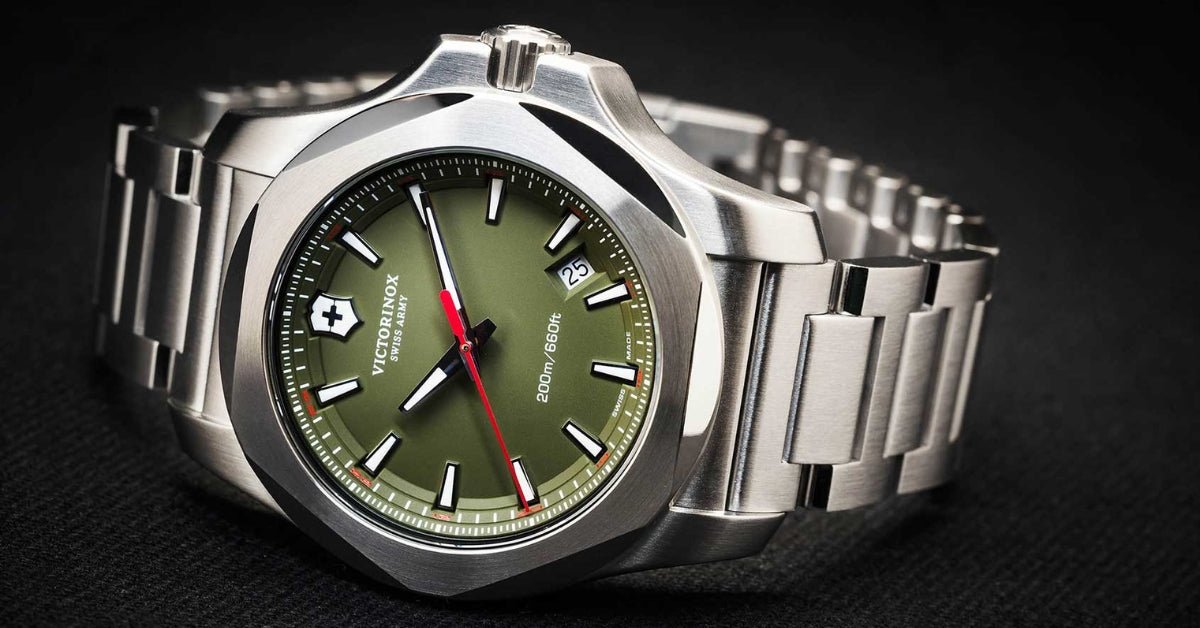
21mm, and it is not in doubt. Victorinox sells its own replacement straps for the INOX at 21mm — rubber, paracord and leather, across a long list of case references — and owners who have measured theirs report the same. The case is 43mm across and just under 14mm thick.
⚠️ Be careful what you read, though. At least one large strap retailer publishes a "best straps for the INOX" page giving 18mm — in a page whose own summary line says 21mm. That is not a subtle error, and pages like it rank. If you have seen 18mm quoted for an INOX, disregard it.
And do not carry the number across the rest of the range. Victorinox spans several widths and the diver and chronograph cases differ. If yours is not a standard INOX, measure the gap between your lugs or send us the reference and we will confirm it.
⚠️ What a 22mm Strap Actually Does
This is the part worth knowing before you take the popular advice, and it comes from an owner who tried it.
A 22mm leather strap will go on — it bunches slightly at the lugs and, from directly above, most people would not notice. That is exactly why the workaround spreads.
But the leather then forms to 21mm. After a day or two of being compressed, the strap end takes a permanent set — and it is no longer usable on a genuine 22mm watch. You do not borrow a 22mm strap for your INOX; you convert it, one way.
The other direction is no better. A 20mm strap leaves half a millimetre of slack at each lug, which lets the strap shift sideways under load and puts all the movement onto the spring bars. And forcing a 22mm strap in has its own problem: owners report struggling to get it back out again.
None of that is necessary. Order 21mm.
Where 21mm Actually Exists
This is the whole reason the workarounds exist: most of the strap trade does not cut 21mm. Makers tool up for 18, 20 and 22mm because those three cover the majority of watches, and the odd numbers get skipped. So an INOX owner searching normally finds nothing and starts improvising.
Our curved-end FKM rubber straps are cut in 18, 19, 20, 21 and 22mm — 21mm is a standard option rather than a special order. So is our LuxLine® range, which runs 20, 21 and 22mm.
The Weight Question
Worth raising, because it changes which strap suits this watch.
The INOX is heavy for its size — owners weighing theirs report around 138 grams complete on the factory rubber, which puts the head alone near 100 grams. That is a lot of mass on a 43mm case.
The factory rubber is deliberately stiff, and that stiffness is doing a job: it supports the weight and stops the case rolling. Owners who have tried the watch on a thin nylon strap describe it flopping around instead.
So this is not a watch for a flimsy strap. You want something with genuine body — a properly made FKM rubber strap has the structure to carry a 100-gram head, where a thin single-pass nylon does not. That is the practical reason rubber suits the INOX beyond the obvious ones.
The Best Straps for a Victorinox INOX
The INOX is a tool watch and it looks best treated as one.
1. Black FKM Rubber — the default and the right one
In 21mm, from the curved-end range. Black works on every dial the INOX comes in, it has the body the watch needs, and it handles everything the INOX was built to survive.
2. A Fine Coloured Line — for the blue and green dials
If your INOX has a coloured dial, repeat it rather than matching it loudly. The black LuxLine® strap with a blue line covers 21mm and keeps the base neutral.
3. Leather — if you want to dress it down
A heavy tool watch on leather is a specific look and it works on the plainer references. Choose something substantial rather than thin — the weight argument above applies to leather too. Our leather range covers the dress-adjacent side. Just make sure it is genuinely 21mm rather than a 22mm you plan to squash.
Fitting
Conventional lugs and conventional spring bars. Face-down on a soft cloth, a proper spring bar tool rather than anything improvised, and tug both ends firmly before the watch goes on your wrist — which matters more than usual here, because a 100-gram head puts real load on those bars.
Keep the factory strap and its hardware together in a bag. The INOX ships with parts that are specific to it, and you will want them if you sell the watch.
The Bottom Line
21mm, not 20mm, not 22mm. The forum workarounds exist because the trade skipped the size, not because the size is a problem — and a 22mm strap squashed onto a 21mm watch is a 22mm strap you have permanently converted.
We cut 18, 19, 20, 21 and 22mm as standard. Every rubber strap carries a lifetime warranty and leather carries one year; shipping is free worldwide with no import costs, and more than 50,000 customers already trust us with their watches.