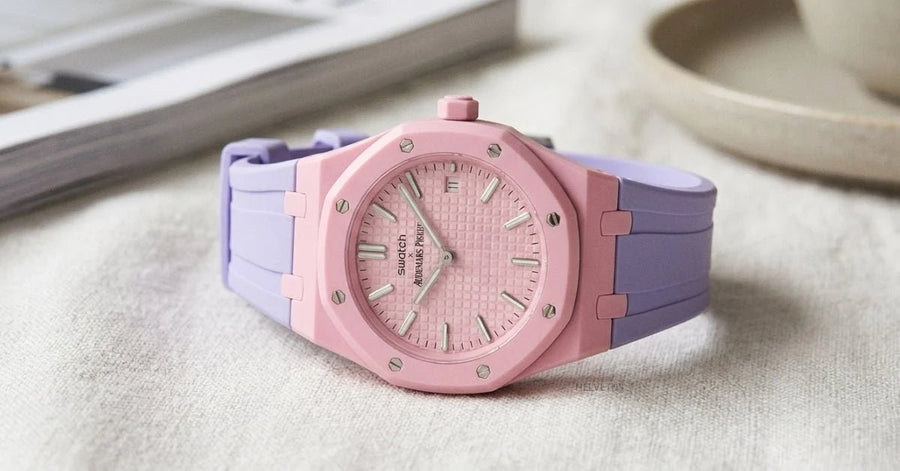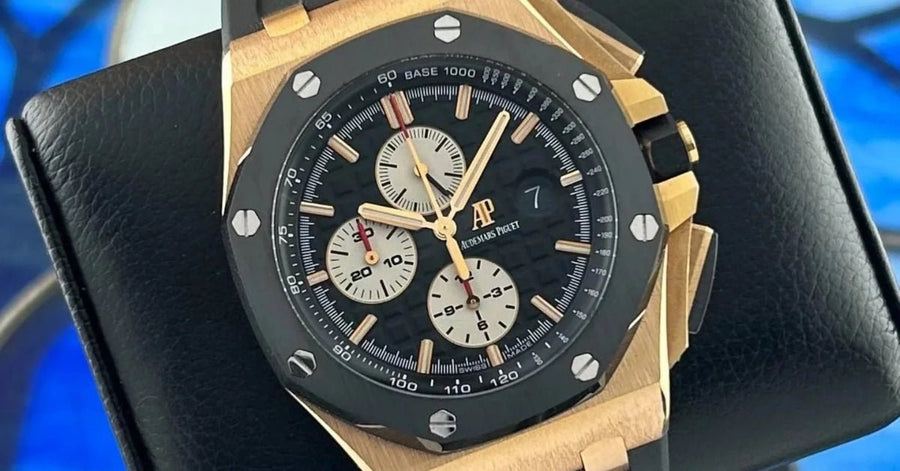



Well, the watch world got it wrong. Almost everyone did. For the past ten days, every major watch publication, every forum thread, every Instagram comment, every WhatsApp group of watch enthusiasts has been debating one question: what will the Swatch x Audemars Piguet Royal Pop actually look like? The consensus was bioceramic. The consensus was Royal Oak silhouette. The consensus was a wristwatch — probably 41mm, probably with the famous tapisserie dial, probably with the integrated bracelet reimagined in colourful Swatch material. Some optimists predicted a modular wrist-or-pendant configuration. Pretty much nobody predicted what AP and Swatch actually delivered.
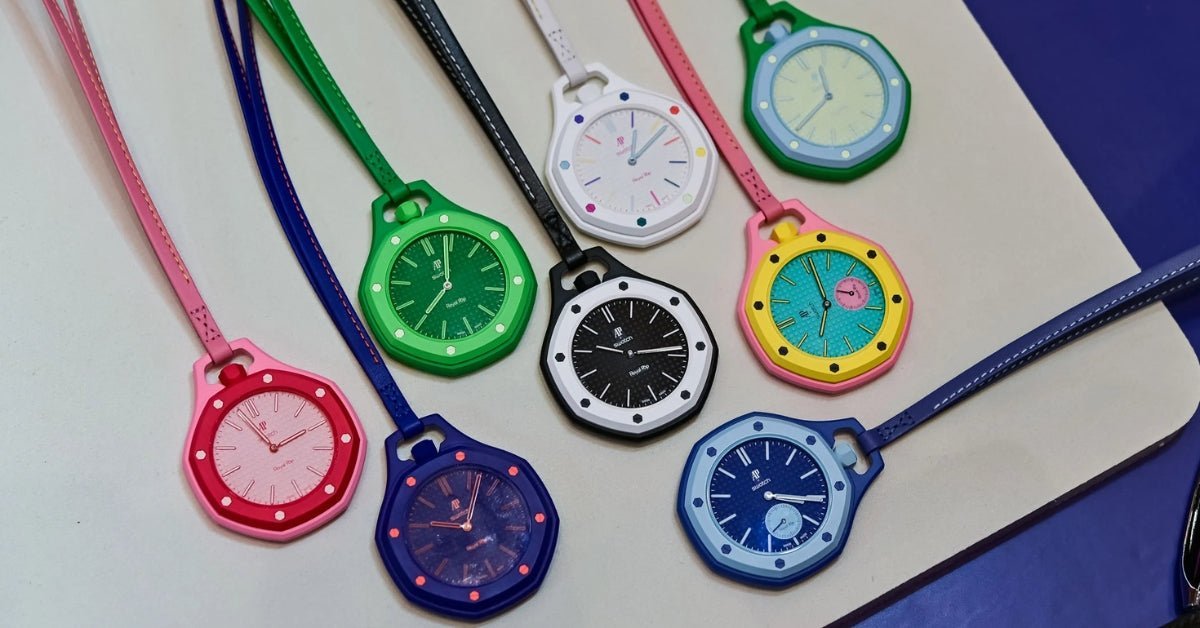
The Royal Pop isn't a wristwatch. It isn't a modular hybrid. It isn't a bioceramic copy of the Royal Oak in any meaningful sense. It's something genuinely different: eight bioceramic pocket watches, worn on calfskin lanyards, powered by a brand-new manually-wound version of Swatch's Sistem51 movement — the first hand-wound Sistem51 in the caliber's twelve-year history. They launch worldwide on Saturday May 16 at 200 selected Swatch boutiques, priced at $400 for the standard Lépine configuration and $420 for the two Savonnette variants. One per person, per store, per day, in-store only. Queues have already started forming outside flagship stores in New York and London as of Tuesday morning.
Here's everything you actually need to know — the format, the eight colourways, the movement, the pricing, the controversy, and how to actually get one on Saturday.
What the Royal Pop Actually Is
The most surprising thing about the Royal Pop isn't the format itself — pocket watches have been having a small but real moment in 2026 — it's how committed AP and Swatch went to the concept. This isn't a pocket watch dressed up to fool you into thinking it's something else. It's a proper, traditional pocket watch in two classical configurations, with all the format's quirks intact, just rendered in colourful bioceramic and powered by a mass-produced Swiss movement.
The design source is real Royal Oak heritage, not the wristwatch you see on celebrities' wrists at Cannes. AP drew specifically on the Royal Oak Pocket Watch reference 5691 — yes, AP has actually made Royal Oak pocket watches before, an ultra-niche reference most enthusiasts have never seen — and used that as the design seed. This is a clever move. It lets the collaboration reference genuine AP heritage without producing a $400 bioceramic copy of the $30,000+ Royal Oak wristwatch.
The case is 40mm in diameter and 8.4mm thick (44.2mm × 53.2mm with the clip mounted), with the unmistakable octagonal bezel and eight visible hexagonal screws that are the Royal Oak's design signature. Vertical satin finishing runs across the bezel and caseback — a Royal Oak detail that most fans would notice immediately. The dial carries the Petite Tapisserie pattern (note: not the Grande Tapisserie used on most modern wristwatch Royal Oaks — Petite Tapisserie is the smaller-grain version that AP uses on more refined references). Hour markers and hands are coated with Grade A Super-LumiNova, glowing properly in the dark in a way no MoonSwatch ever has. Both front and back of the case have sapphire crystals — also unusual for Swatch, which typically uses acrylic.
The two configurations are textbook 19th-century pocket-watch styles:
Lépine (six of the eight references) — Crown at 12 o'clock, hours and minutes only on the dial, no seconds hand. This is the open-face style most commonly associated with traditional pocket watches.
Savonnette (two of the eight references — Lan Ba and Otg Roz) — Crown at 3 o'clock, small seconds at 6 o'clock. Also called "hunter case" historically, though the Royal Pop doesn't have a hinged cover. The side-winder layout is what distinguishes these from the Lépine references.
The watch clips into a bioceramic holder attached to a colour-matched calfskin lanyard. Helvetus's editorial position: the lanyard is genuinely well-made. It's calfskin with contrast stitching, properly finished, and the bioceramic clip mechanism feels engineered rather than thrown together. Whether you actually wear a pocket watch around your neck in 2026 is a separate question — and the answer is going to determine whether the Royal Pop becomes a cultural object or a curiosity within six months — but the execution of the lanyard system itself is solid.
The Movement: A Genuine Horological First
This is the part of the Royal Pop most coverage is glossing over, and it's actually significant. The watch is powered by a brand-new, hand-wound version of the Sistem51 — and this is the first time the Sistem51 has ever been adapted for manual winding in its history.
The Sistem51 is Swatch's signature movement, introduced in 2013, famous for being the only mechanical watch movement in the world assembled entirely by automated processes — no human hands involved in the assembly. The standard Sistem51 is automatic. It uses a central rotor that swings as you wear the watch, winding the mainspring. For a pocket watch, you obviously can't have a rotor doing useful work — pocket watches don't move enough during normal wear to wind themselves — so AP and Swatch built a new manual-wind version specifically for the Royal Pop.
The specs are genuinely impressive for a $400 watch:
- 15 active patents — these aren't decorative claims, they're real patent filings for the engineering
- 90+ hours of power reserve — significantly more than most automatic watches at any price point
- Nivachron balance spring — this is the non-magnetic, titanium-based alloy that Swatch Group and Audemars Piguet jointly developed and patented in 2018. It reduces the influence of magnetic fields on watch accuracy by a factor of 10–20 compared to traditional balance springs. Having this in a $400 watch is actually remarkable
- Laser-based precision adjustment performed at the factory — meaning each piece is regulated for accuracy rather than just assembled and shipped
- 21,600 vph (3 Hz) beat rate, in line with most modern mechanical movements
- Engineered without a central screw — confirmed by Swatch's own marketing materials, suggesting the peripheral rotor architecture that watch enthusiasts had speculated about. This is a structural innovation in addition to the manual-wind conversion
The barrel drum doubles as a visible power reserve indicator through the sapphire caseback. When the barrel chambers appear grey, the mainspring is unwound — wind the watch. When the chambers appear gold, the mainspring is fully compressed and the watch is at full power. This is a clever and visually distinctive feature you don't get on the standard automatic Sistem51.
Why does the movement matter so much for the Royal Pop's positioning? Because it's the strongest argument against the "this cheapens the Royal Oak" critique. A $400 watch with 15 patents, a Nivachron balance spring, 90-hour power reserve, sapphire crystals on both sides, and laser-regulated accuracy is a genuine horological object, not a costume piece. The MoonSwatch was a quartz-powered fashion item. The Royal Pop is closer to a serious mechanical pocket watch at an accessible price than to a novelty.
The Eight Colourways, In Order of Likely Demand
Each of the eight references is named with the word "eight" translated into a different language — a wink at the Royal Oak's octagonal bezel and its eight visible screws. The naming is genuinely thoughtful, hitting eight different language families spread across Europe and Asia. Here's each piece with its colourway, configuration, and what makes it distinctive.
Otto Rosso (Italian — "Eight Red") — Lépine — $400 — Ref. SSX03R100N Pink case with deep red bezel. The most immediately attention-grabbing of the eight, and almost certainly the first to sell out at every store on launch day. The colour combination is bold without being garish, and the red bezel echoes some of AP's classic Royal Oak references with red highlights. Currently the most-discussed colourway in collector forums and the strongest secondary-market prediction.
Huit Blanc (French — "Eight White") — Lépine — $400 — Ref. SSX03W100N White bioceramic case with the eight bezel screws assembled in randomly varied colours — meaning Swatch has confirmed that approximately three million possible colour combinations exist, and every Huit Blanc ever produced is therefore mathematically unique. This is genuinely a clever piece of design — what was a structural element (the screws) becomes a randomised colour celebration, and every owner gets a one-of-a-kind piece. This is the colourway watch enthusiasts are most quietly excited about because of the uniqueness factor. Expect resale prices to vary dramatically by which specific combination of screws each individual piece has.
Green Eight (English — green) — Lépine — $400 — Ref. SSX03G100N Sage green case with darker green bezel. The most quietly wearable piece in the collection — the sleeper pick that won't go viral but will photograph beautifully and age gracefully. If you want a Royal Pop that doesn't shout "I queued for this at 4am," Green Eight is the choice.
Blaue Acht (German — "Blue Eight") — Lépine — $400 — Ref. SSX03L101N Lime green case with light blue bezel. Surprisingly harmonious despite the unusual colour pairing. Sits somewhere between the louder pieces and the more restrained options.
Orenji Hachi (Japanese — "Orange Eight") — Lépine — $400 — Ref. SSX03L103N Navy blue case with orange accents. This colourway has the most traditional-watch-design feel of the eight — the deep navy with single accent colour echoes classic dress and tool watch styling. Probably the second-most-collectible Lépine after Otto Rosso.
Ocho Negro (Spanish — "Eight Black") — Lépine — $400 — Ref. SSX03W101N Black case with white accents — the graphic anchor of the collection. Works with the widest range of outfits and aesthetic registers. The everyday-carry choice for someone who actually intends to wear the Royal Pop regularly rather than as a statement piece. This is the option for collectors who like the concept but don't want to commit to a loud colourway.
Lan Ba (Chinese — "Blue Eight") — Savonnette — $420 — Ref. SSX03L100N Multi-tone blue with darker blue case and lighter blue bezel, with small seconds at 6 o'clock and crown at 3 o'clock. One of only two Savonnette references in the collection. The traditional-watch-design lean continues here — Lan Ba is the choice for buyers who want the more "watch-like" of the two Savonnette options.
Otg Roz (Romansh — "Eight Pink") — Savonnette — $420 — Ref. SSX03J100N Pink case with bright yellow bezel and teal dial. Officially inspired by Andy Warhol's Marilyn Monroe paintings — confirmed by AP. The most maximalist piece in the collection by some distance, and probably the most coveted because of the explicit pop-art lineage and Warhol reference. Most likely to command the highest secondary-market premium. If you're buying one Royal Pop as a collector's piece rather than for daily wear, this is the one.
Note on Romansh: Romansh is the fourth official language of Switzerland (alongside German, French, and Italian), spoken in some Alpine cantons. Using it for the most distinctive colourway in the collection is a quiet Swiss-pride detail that most non-Swiss observers won't catch — and that watch enthusiasts familiar with Swiss culture will appreciate.
Pricing and Availability
Pricing is firm across major markets:
- United States: $400 (Lépine) / $420 (Savonnette)
- Eurozone: €385 (Lépine) / €400 (Savonnette)
- United Kingdom: From £335 (Lépine) / approximately £355 (Savonnette)
- Switzerland: CHF 350 (Lépine) / CHF 375 (Savonnette)
Taxes are excluded from these prices and vary by market. The $20 premium for the Savonnette variants reflects the added small seconds complication and the more complex movement layout — frankly, $20 is barely a meaningful difference for the added horological content.
Distribution: 200 selected Swatch boutiques worldwide. Confirmed participating store counts:
- United Kingdom: 13 stores (5 in London, plus Birmingham, Edinburgh, Glasgow, Manchester, Liverpool)
- United States: 21 stores (New York, LA, Houston, Las Vegas, Miami, and others)
- Switzerland, France, Germany, Italy, Spain: Multiple flagship locations each
- Hong Kong, Singapore, Tokyo, Seoul, Bangkok, Dubai, Sydney, Melbourne: Major Asia-Pacific and Middle East locations
- Major markets across Europe, the Americas, and Asia-Pacific are all covered through the 200-store global rollout
Strict purchase limits: One Royal Pop per person, per store, per day. Enforced. No exceptions. You cannot game this by visiting multiple stores in the same city in one day — Swatch has indicated stores will coordinate on suspected duplicate purchase attempts.
Online sales: None at launch. The Royal Pops themselves are exclusively in-store. However, accessories are sold online — additional longer lanyards in different colours, the bioceramic desk clock stand mount, and additional bioceramic clip holders are available through Swatch's website. These do not carry the Royal Pop branding but allow Royal Pop owners to customise wear after launch.
No confirmed production limit, but officially a "one-off" collaboration. This is a critical detail. Unlike the MoonSwatch, which Swatch has continued expanding for four years with countless variants, the Royal Pop has been confirmed by both Swatch and AP as a one-time collection that will not be eternally extended. Production may run 8 to 18 months before the collection is permanently discontinued. This is the key scarcity argument for collectors — and the reason secondary market premiums are likely to be more durable than they've been for MoonSwatch references.
Where Did the Pocket Watch Idea Come From?
This is the part of the story that makes the Royal Pop more interesting than a typical Swatch collab, and it's worth understanding because it shapes whether the watch is worth queuing for.
The "Pop" in Royal Pop isn't a reference to pop art — at least not primarily. It's a reference to the Swatch POP collection from 1986. The original Pop Swatch was a Swatch innovation: a watch with a removable head that could be popped out of its housing (hence the name) and clipped to clothing, attached to a bag strap, hung on a keychain, or worn as a pendant on a cord. It was one of the most distinctive Swatch products of the 1980s and was in production for roughly a decade before fading away. The Pop concept was revived briefly in 2022 alongside the MoonSwatch's success.
The Royal Pop directly inherits this design philosophy. The watch case clicks (the "Clac!" sound from Swatch's teaser campaign) in and out of its bioceramic holder. You can wear it on the calfskin lanyard around your neck, clip it to a bag, slip it into a jacket or trouser pocket, or — with the optional desk stand accessory — display it as a tiny desk clock at home or at your workplace.
This makes the Royal Pop genuinely unusual. The MoonSwatch was a wristwatch. The Bioceramic Scuba Fifty Fathoms was a wristwatch. The Royal Pop is a deliberate format experiment that asks the question: is there a market for a serious-ish mechanical pocket watch in 2026? Pendant watches and pocket watches have been having a small fashion moment — Hublot just released a Daniel Arsham-designed pendant watch, Cartier's Santos was visibly worn as a pendant at the 2026 Met Gala by Irina Shayk, several luxury brands have explored non-wrist configurations. The Royal Pop is the most commercially ambitious entry in that fashion-and-horology crossover space.
Whether you actually wear a pocket watch around your neck depends entirely on your personal style. The Royal Pop almost certainly looks better hanging from a Birkin handle or clipped to a leather Tote at Watches & Wonders next year than it does in your shirt pocket at the office. Swatch and AP are clearly betting on the lanyard and fashion-accessory use cases, not on a pocket-watch revival.
What Audemars Piguet Is Actually Doing With the Money
This is genuinely interesting and worth highlighting because it changes the corporate-collaboration calculus. Audemars Piguet has confirmed that 100% of its proceeds from the Royal Pop collaboration will fund a dedicated initiative supporting the preservation and transmission of watchmaking savoir-faire — focused on rare watchmaking skills and the next generation of horological talent.
This is unusual. In most luxury watch collaborations, both parties are in it for the commercial returns. By committing all proceeds to a watchmaking education foundation, AP is positioning the Royal Pop less as a commercial venture and more as a brand-building exercise with a charitable wrapper. It also gives AP a strong public response to the critique that the collaboration "cheapens" the Royal Oak — AP can credibly say the project is about cultivating future watchmaking talent and reaching new audiences, not about extracting commercial value from the Royal Oak's brand equity.
Swatch's commercial interest is more straightforward. They make the watches, they sell them, they keep the proceeds. Swatch has been clear from the start about wanting to drive footfall into physical retail, generate cultural conversation, and continue the icon-collaboration playbook that's been working since 2022.
The Collector Backlash: Real, But Smaller Than Predicted
Pre-launch, a meaningful contingent of watch enthusiasts predicted the Royal Pop would be a disaster for AP's brand. Some traditional Royal Oak collectors have been vocal that the collaboration "cheapens" or "dilutes" what they see as one of the most exclusive sport-luxury watches in horology. Several watch industry insiders posted on Instagram describing the Royal Pop as "a travesty" or "RIP the Royal Oak."
But the actual launch reaction has been more measured than predicted. A few specific things have softened the backlash:
The pocket watch format genuinely matters. Most of the pre-launch criticism was based on the assumption the Royal Pop would be a bioceramic Royal Oak wristwatch — a $400 piece that would compete visually with the $30,000 original on people's wrists. By making it a pocket watch, AP and Swatch have created enough format distance that the Royal Pop doesn't compete with the Royal Oak on the wrist. As Worn & Wound's editorial put it: the pocket watch decision "makes the Royal Pop a genuine novelty, and prevents it from being mistaken as a Royal Oak knockoff."
The horological substance is real. A new hand-wound Sistem51 with 15 patents and a Nivachron balance spring isn't a costume piece. The Royal Pop has more watchmaking content than many traditional collector watches at 2–3x its price. This makes it harder to dismiss as a fashion novelty.
The proceeds-to-education angle is genuinely compelling. A traditional Royal Oak collector criticising AP for "selling out" with this collaboration has to grapple with the fact that AP is donating all of its proceeds to watchmaking education. The moral high ground is harder to claim against a charitable component.
Eight pieces, one-off collection. Unlike the MoonSwatch's now-bloated catalogue (countless variants, many of which feel cynical), the Royal Pop is explicitly a finite collection. Eight pieces, one production run, no eternal expansion. The scarcity argument supports the Royal Pop as a collector's object in a way the MoonSwatch lost two years ago.
That said, the backlash is real and worth acknowledging honestly. Some longtime AP collectors are genuinely upset. The Watch Collecting Lifestyle editorial that called the collaboration "RIP the Most Iconic Steel Sports Watch at the Price of Gold" speaks for a non-trivial slice of established AP buyers. The argument: the Royal Oak earned its status through decades of careful brand management around exclusivity, and turning the silhouette into a $400 pocket watch sold to anyone who queues represents a fundamental break with that legacy.
Both views have merit. Whether the Royal Pop is bad for the Royal Oak's long-term brand equity is a question that won't be answered for at least 3-5 years. What's clear is that the launch will be enormous — and the established Royal Oak collector base who hates the collaboration is significantly outnumbered by the new audience that will queue for one on Saturday.
How to Actually Get One on Saturday May 16
Practical advice based on the established patterns from the MoonSwatch and Bioceramic Scuba Fifty Fathoms launches, updated for the Royal Pop's specific dynamics.
1. Decide which colourway you want before Saturday. Stock per store will be limited and varied by reference. If you're inflexible on a specific colourway — particularly Otto Rosso, Otg Roz, or Huit Blanc — you may need to choose your store carefully and queue much earlier. If you're flexible across the eight pieces, your odds of leaving with something improve significantly. Be honest with yourself about which one you actually want before you commit to standing in line for hours.
2. Identify your nearest participating store and confirm it's on the list. Use Swatch's official store locator with the Royal Pop filter. The 200-store global rollout is significant but not exhaustive — many Swatch stores are not participating. Don't assume your local store will have stock.
3. Plan to queue earlier than you think. The MoonSwatch saw 12+ hour queues in major cities. The Royal Pop is likely to see worse, particularly because the Sistem51 hand-wound movement and the AP connection have generated more genuine horological interest than the MoonSwatch did in 2022. UK industry publication Stuff has indicated their team plans to be outside their target store from 4am. New York City reports already have people camping outside select stores as of Tuesday. For major cities, 24+ hour queues are realistic. Plan accordingly.
4. One per person, per store, per day. Strictly enforced. No friends-of-friends arrangements, no "I'll buy two for my collection." Don't even try.
5. Bring proper supplies. Saturday May 16 weather varies wildly by location. Phone charger. Snacks. Water. Layers. Something to read or watch. The queue is part of the experience and there's no shortcut. If you're queuing overnight, bring a foldable chair if your local Swatch store allows it.
6. Card payment is standard. Swatch retail uses contactless and chip cards at every location. Some markets accept cash; not all. Card is the safe default.
7. The secondary market opens immediately. Expect Royal Pops to appear on eBay, StockX, and grey market sites within hours of launch day at 2-5x retail prices initially, with the most desirable colourways (Otg Roz, Otto Rosso, Huit Blanc) potentially commanding 5-10x retail in the first week. Resale premiums will likely settle to 1.5-3x retail by mid-summer as initial scarcity moderates. If you specifically want a Royal Pop and can't queue, the secondary market is an option — but plan to pay $1,500–$3,000 for the most coveted variants in the first few weeks.
8. Don't take it out on retail staff. Swatch retail teams have already lived through the MoonSwatch chaos and will live through this one. They're not the cause of stock limits or the queue. Being nice doesn't get you a watch faster, but being awful doesn't either.
How the Royal Pop Compares to the MoonSwatch and Bioceramic Scuba Fifty Fathoms
For anyone who's owned or queued for the previous Swatch icon collaborations, here's how the Royal Pop differs.
vs MoonSwatch (Omega x Swatch, March 2022): The MoonSwatch was a quartz wristwatch at $260, available in 11 launch variants, and Swatch has since expanded the line dramatically with countless additional Missions, Moonshine Gold editions, and themed releases. The Royal Pop is a hand-wound mechanical pocket watch at $400-420, available in 8 variants, and explicitly a one-off collection that won't be expanded. The Royal Pop is more expensive (~50% higher entry price), more horologically substantial (mechanical vs quartz), more limited in format, and more committed as a one-time release. Format-wise they're completely different products — wrist vs pocket watch.
vs Bioceramic Scuba Fifty Fathoms (Blancpain x Swatch, September 2023): The Bioceramic Scuba Fifty Fathoms was an automatic-Sistem51 wristwatch at slightly higher pricing than the MoonSwatch, available in 5 Ocean variants plus subsequent Green Abyss and Scubaqua additions. The Royal Pop's manual-wind Sistem51 is mechanically more interesting than the standard auto Sistem51 in the Scuba Fifty Fathoms (15 patents, 90-hour reserve vs the standard caliber's specs). The Royal Pop also has sapphire crystals front and back, where the Bioceramic Scuba Fifty Fathoms uses acrylic — a real upgrade in materials.
The Royal Pop's unique characteristics:
- First Swatch icon collaboration with an independent (non-Swatch Group) watchmaker
- First hand-wound version of the Sistem51 in the caliber's history
- First Swatch pocket-watch icon collaboration
- First Swatch collaboration with full sapphire crystals on both sides
- 100% of AP's proceeds going to watchmaking education (unusual corporate structure)
- Smallest variant count of the three icon collaborations (8 vs 11+ for MoonSwatch and 5+ for Fifty Fathoms)
- Explicit one-time collection rather than expandable line
Why This Matters for the Future of Luxury-Mass Market Collaborations
The Royal Pop is a watershed moment beyond just being a watch launch. It's the first time a "Holy Trinity" independent Swiss watchmaker (Patek Philippe, Audemars Piguet, Vacheron Constantin — the three brands that traditionally sit at the apex of haute horlogerie) has formally collaborated with a mass-market brand at the Swatch tier. This breaks a precedent that's been intact for over a century.
For the luxury watch industry, the Royal Pop will be a test case watched extremely carefully by:
Patek Philippe — historically the most exclusivity-focused of the Trinity, who will be assessing whether the Royal Oak collaboration helps or hurts AP's long-term brand positioning. If Royal Oak prices hold and the Patek Philippe model can avoid the same democratization pressure, Patek will likely never collaborate with Swatch. If the Royal Pop causes any noticeable Royal Oak softening, Patek might pivot.
Vacheron Constantin — the third member of the Trinity, less hype-driven than the other two, currently somewhat under-the-radar in mass cultural awareness. A Vacheron x Swatch collaboration would have less obvious tension than the AP version, and could plausibly happen within 2-3 years if Vacheron decides cultural relevance is more important than maximum exclusivity.
Richard Mille — the modern luxury sport watchmaker who has built brand equity primarily through scarcity and pricing. Richard Mille seems extremely unlikely to participate in any Swatch-tier collaboration, but the Royal Pop might shift their calculations slightly.
LVMH watch brands (Hublot, Tag Heuer, Bulgari, Zenith) — could theoretically partner with Swatch's competitors at a similar accessible-icon tier. Casio has shown interest in this space with the G-Shock "CasioOak" homage that AP almost certainly noticed.
For the watch industry generally, the Royal Pop establishes a new template: independent luxury watchmaker partners with Swatch on a one-off, finite collection, with proceeds donated to watchmaking education, in a non-wristwatch format that doesn't compete with the original luxury reference. That's a much more sustainable model for accessible-luxury collaborations than the MoonSwatch's open-ended expansion, and it preserves more of the source brand's equity. Expect copycats — and expect this model to spread.
Will the Royal Pop Hold Its Value?
The resale market question is one most prospective buyers care about. Based on the established patterns from previous Swatch icon collaborations and the specific characteristics of the Royal Pop, here's a realistic prediction.
Short-term (May 16 through end of June): Expect 3-10x retail on the secondary market for the most coveted variants (Otg Roz, Otto Rosso, Huit Blanc). Lesser-demand variants (Green Eight, Ocho Negro, Blaue Acht) will likely run 1.5-2.5x retail. Total launch-day secondary market value across all variants: probably $1,500-$3,000 per piece on average.
Medium-term (July-December 2026): Premiums likely to moderate as initial scarcity moderates and second waves of inventory reach less-prioritised stores. Expect 2-4x retail for the most desirable variants, 1.2-1.8x for the rest.
Long-term (2027 and beyond): This is where the Royal Pop diverges from the MoonSwatch. Because the Royal Pop is a one-time collection that won't be continuously expanded, scarcity is more durable. The Otg Roz (the Warhol-Marilyn variant) and Huit Blanc (the random-colour-screws unique-each-piece variant) are likely to maintain premium values long-term as collector pieces. The Lépine variants in standard colourways may settle closer to retail or modest premiums as they become genuinely available on secondary markets.
Lottery winners in the Royal Pop: Otg Roz, Huit Blanc, Otto Rosso. Long-term collector picks: Otg Roz (Warhol provenance), Huit Blanc (unique-each-piece factor), Lan Ba (Savonnette format). Volume play for someone who actually wants to wear one: Ocho Negro, Green Eight, Blaue Acht. First-day sales out: Otto Rosso, Otg Roz, Huit Blanc — almost certainly across most stores.
What This Means for Strap Buyers and Royal Oak Owners
Two specific groups of watch enthusiasts should pay attention to what happens after May 16.
For actual Royal Oak owners. The Royal Pop is unlikely to affect the resale value of your watch. The historical pattern from the MoonSwatch / Speedmaster relationship suggests the opposite — accessible-tier collaborations have consistently increased awareness and demand for the original luxury reference rather than diluting it. The Royal Pop is also a pocket watch, not a wristwatch — meaning the silhouette competition with your Royal Oak on the wrist doesn't exist. Your watch retains its full visual identity. If anything, the Royal Pop will introduce new younger and broader audiences to the Royal Oak's design language, building long-term aspiration for the real thing.
For aftermarket strap buyers. This is where things get interesting. The Royal Pop ships on a calfskin lanyard rather than a wristwatch strap, but the watch is genuinely designed to be popped out of its housing — which opens up modular accessory possibilities. Expect aftermarket lanyards, alternative-colour clips, and possibly even wristwatch conversion kits within weeks of launch as specialist makers respond to demand.
For owners of the actual AP Royal Oak family, the Royal Pop launch is genuinely good news. Increased Royal Oak design awareness translates to renewed interest in the entire integrated-bracelet sport-luxury category, including the aftermarket strap options that work with Royal Oak references. Helvetus has been making premium aftermarket straps for the Royal Oak family for years, and the Royal Pop moment is likely to drive new attention to aftermarket strap options for the original watch reference. Premium FKM rubber, sailcloth, and specialist leather options for the Royal Oak family have always been a quiet collector category — the Royal Pop moment may bring them into broader visibility.
Frequently Asked Questions
When does the Royal Pop launch? Saturday, May 16, 2026. Global in-store synchronised launch.
How much does the Royal Pop cost? $400 for the six Lépine references (Otto Rosso, Huit Blanc, Green Eight, Blaue Acht, Orenji Hachi, Ocho Negro). $420 for the two Savonnette references (Lan Ba, Otg Roz). UK pricing from £335. Eurozone €385 / €400. Switzerland CHF 350 / CHF 375. Taxes excluded.
Where can I buy the Royal Pop? At 200 selected Swatch boutiques worldwide. In-store only. Online sales are not available for the watches themselves (though accessories — additional lanyards, desk stands, additional clip holders — are sold online). Use Swatch's official store locator with the Royal Pop filter to find your nearest participating store.
Is the Royal Pop a wristwatch? No. The Royal Pop is a pocket watch designed to be worn on a calfskin lanyard around the neck, clipped to a bag, slipped into a pocket, or displayed on a desk stand. It's not designed for wrist wear.
Is the Royal Pop limited edition? The Royal Pop has no confirmed production limit, but both Audemars Piguet and Swatch have confirmed it as a one-off collaboration that will not be eternally expanded. Production is likely to run 8-18 months before the collection is permanently discontinued.
What movement does the Royal Pop use? A brand-new hand-wound version of Swatch's Sistem51 movement — the first manual-wind Sistem51 in the caliber's history. 15 active patents, 90-hour power reserve, Nivachron anti-magnetic balance spring, laser-based factory regulation. Built specifically for the Royal Pop.
How many Royal Pop variants are there? Eight references total. Six Lépine-style references with crown at 12 o'clock and hours-and-minutes display: Otto Rosso, Huit Blanc, Green Eight, Blaue Acht, Orenji Hachi, Ocho Negro. Two Savonnette-style references with crown at 3 o'clock and small seconds at 6 o'clock: Lan Ba, Otg Roz.
Why is the Huit Blanc special? Each Huit Blanc reference has its eight bezel screws assembled in randomised colours from a palette of options, meaning approximately three million possible colour combinations exist. Every Huit Blanc ever produced is therefore mathematically unique — no two are identical. Swatch has confirmed this explicitly.
What's the deal with Otg Roz and Andy Warhol? The Otg Roz colourway (pink case, yellow bezel, teal dial) is officially inspired by Andy Warhol's Marilyn Monroe paintings. The combination of pop-art lineage, Savonnette format, and the most distinctive colour palette in the collection makes it the most collectible piece in the lineup. Expect the highest secondary-market premiums on Otg Roz.
What does AP get from the collaboration? AP has committed 100% of its proceeds from the Royal Pop to a dedicated initiative supporting the preservation and transmission of watchmaking savoir-faire, with focus on rare horological skills and the next generation of watchmaking talent. AP is not extracting traditional commercial value from the collaboration.
Can I wear the Royal Pop on my wrist? Not as designed. The Royal Pop is a pocket watch with a lanyard. Some buyers will likely attempt aftermarket wrist conversions using straps, but the watch is engineered for pendant/pocket/desk display rather than wrist wear.
Does the Royal Pop affect the Royal Oak's value? No — and the historical pattern suggests it may increase Royal Oak awareness and demand long-term. The pocket-watch format means it doesn't compete with the Royal Oak's wrist presence. Royal Oak collectors should not see any negative impact on their watch's value from the Royal Pop launch.
Will there be more Royal Pop variants in 2027? Almost certainly not. Both AP and Swatch have confirmed this as a one-off collection. The eight references are likely the entire production for the collaboration's lifetime.
Is the Royal Pop worth queuing for? That depends entirely on your priorities. If you want a serious mechanical pocket watch at an accessible price, with genuine horological substance and a unique format, yes. If you wanted a bioceramic Royal Oak wristwatch — sorry, that's not what this is. If you're queuing as a flip play, yes. If you're queuing as a watch collector who genuinely appreciates the format, yes. If you're queuing because everyone else is queuing — you'll probably enjoy the experience but you may not love what you walk away with.
The Bottom Line
The Audemars Piguet x Swatch Royal Pop is one of the most genuinely surprising watch launches of the decade. Almost nobody predicted the pocket watch format. Almost nobody predicted the hand-wound Sistem51 first. Almost nobody predicted the proceeds-to-watchmaking-education structure. Almost nobody predicted that the most controversial collaboration in modern Swiss horology would arrive with this much considered restraint.
It's not a bioceramic Royal Oak wristwatch. It's something genuinely different — a colourful Pop Art pocket watch with real horological substance, a real connection to AP's own pocket watch heritage (Royal Oak Pocket Watch reference 5691), and a finite collection structure that makes it more collectible than its predecessors. At $400-420 with a sapphire-fronted case, hand-wound Sistem51, Nivachron balance spring, and 90 hours of power reserve, the Royal Pop is also a horologically serious object at an accessible price — closer to a genuine watch collector's pocket piece than to the MoonSwatch's fashion-novelty register.
The eight colourways span from genuinely wearable (Ocho Negro, Green Eight) to fully unhinged in the best way (Otg Roz, Huit Blanc). The two Savonnette variants are the more collectible because of their rarity within the collection — only 2 of 8 references — and the Otg Roz specifically because of the Andy Warhol Marilyn provenance. The Huit Blanc is the secret gem because every piece ever produced is mathematically unique.
Queues will form. Stores will close early. Resale prices will spike. Royal Oak collectors will divide into Royal Pop enthusiasts and Royal Pop critics, and both groups will be wrong about the long-term significance. What the Royal Pop represents — independent watchmaker, finite collection, format experimentation, horological substance, charitable proceeds, brand-building rather than revenue extraction — is the new template for luxury-mass collaborations. We'll be seeing more like this in the next five years. The Royal Pop just got there first.
If you're queuing for one on Saturday, May 16: good luck. Pick your colourway before you arrive. Bring patience and supplies. Be respectful to retail staff. Whatever you walk away with — Otto Rosso, Otg Roz, Huit Blanc, or any of the others — you're walking away with a piece of horological history.
Helvetus has been making premium aftermarket straps for the actual Audemars Piguet Royal Oak family for years, and the Royal Pop moment will likely drive new attention to aftermarket options across the entire Royal Oak collection. If you own a Royal Oak — or if you're a Royal Pop owner thinking about how the lanyard system could be customised — keep an eye on our curved-end FKM rubber and Rolex Strap collections for Royal Oak-compatible options. Browse the full range at helvetus.com, use our Strap Finder to match the right strap to your specific watch reference, or read more on the Helvetus blog.