


If you've spent more than ten minutes shopping for a replacement watch strap, you've come across the terms "curved end" and "straight end" — and unless someone explained the difference, you probably guessed which one your watch needs and clicked buy. About half the time, that guess is wrong.
The difference between the two isn't subtle once you know what to look for, and it's the single biggest reason people end up returning watch straps. A straight-end strap on a watch designed for curved end leaves a small, visible gap at the case that you'll notice every time you look at your wrist. A curved-end strap on a watch designed for straight end can rub against the case, leave the wrong silhouette, or simply not fit at all. Material, colour, and length all matter — but if you get the end-fit wrong, none of the rest of it does.
This guide covers exactly what each one is, why both exist, when you need which, and which specific watches need which end-fit. By the end you should be able to look at any watch and know within a few seconds which strap end will work.
What "End Fit" Actually Means
Every two-piece watch strap connects to the watch through the lugs — the metal arms that protrude from the top and bottom of the case. The very end of the strap, the part that sits between the lugs, can be cut in one of two shapes.
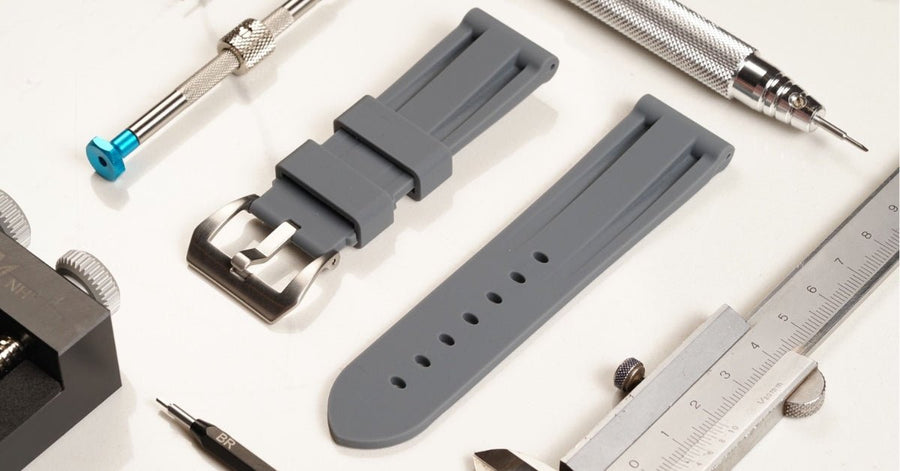
Straight end is exactly what it sounds like. The strap end is cut in a flat, straight line, perpendicular to the length of the strap. It slots between the lugs and there's a small visible gap between the strap end and the curved interior of the case. This is the traditional, universal cut — the same cut used on virtually every leather strap from the early days of wristwatches through to most modern dress watches.
Curved end has the strap end cut in a concave curve that mirrors the profile of the watch case. When the strap is fitted, the curved end sits flush against the case with no visible gap. From any normal viewing distance, the strap appears to be a continuous extension of the watch — there's no obvious "break" between case and strap. This is the cut Rolex uses on the OEM Oysterflex bracelet, Patek Philippe pioneered on the Aquanaut, and what most modern aftermarket sport-watch straps now offer for specific watch references.
Critically, the curve is reference-specific. A curved-end strap cut for a Rolex Submariner won't sit flush on an Omega Speedmaster, because the case profiles are different. This is the part that confuses people the most: a 20mm straight-end strap fits any 20mm watch, but a 20mm curved-end strap is generally cut for one specific watch reference and looks wrong on others.
Why Curved-End Straps Exist At All
For most of wristwatch history, all leather straps were straight end. The small gap between case and strap was just how watches looked — leather was the material of choice, and a slight visible gap at the lugs was barely noticeable on a thin dress watch. Nobody minded.
The shift came with modern sport watches and integrated case design. Two things happened in parallel from the 1970s onward. First, watch cases became more sculptural — the Royal Oak (1972), the Nautilus (1976), and later the Aquanaut (1997) were all designed as single integrated objects where the bracelet flowed visually out of the case. A traditional straight-end strap on these watches looked wrong because the case was designed to continue, not to terminate sharply at a strap edge.
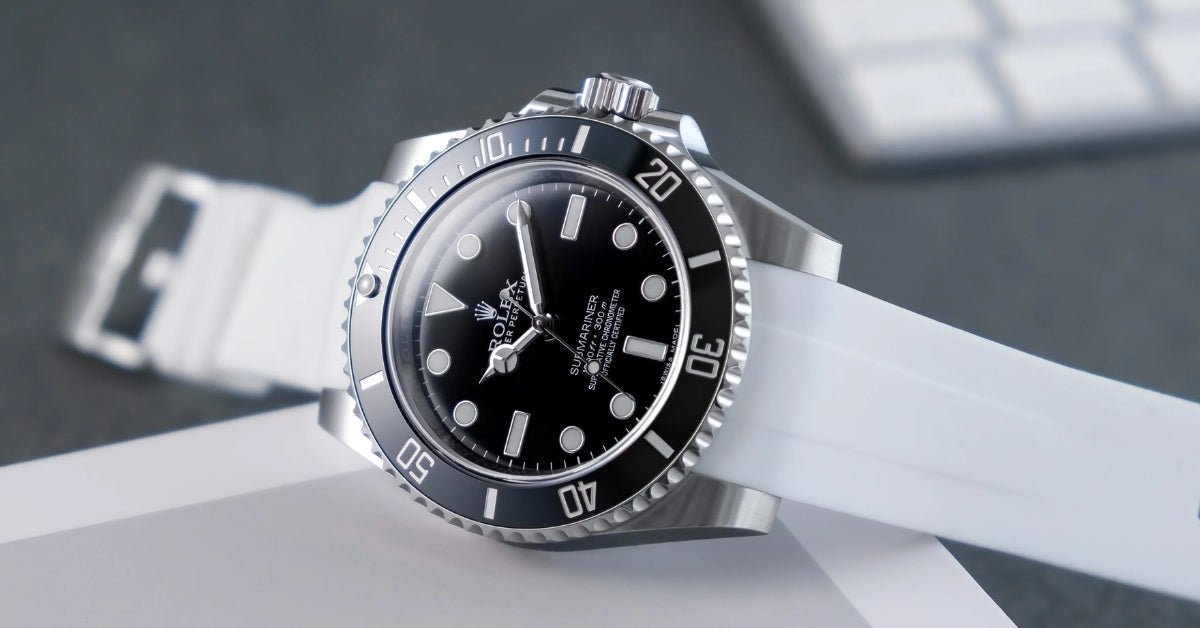
Second, sport-luxury watches got tighter case tolerances. Modern dive watches, chronographs, and GMTs often have very little clearance between the spring bar and the inside curve of the case. A standard straight-end strap on a Rolex Submariner, for example, leaves the spring bar visible at the sides — and depending on the strap thickness, the strap end can rub against the case during normal wrist movement.
Curved-end straps solved both problems at once. The curved cut hides the spring bar, follows the case profile for a flush silhouette, and on watches with tight clearance it actually fits where a straight-end strap can't. This is why every premium aftermarket strap brand now offers curved-end options for specific Rolex, Cartier, Omega, Tudor, Patek, and AP references.
When You NEED a Curved-End Strap
There are three situations where a curved-end strap is clearly the right choice and a straight-end will look or fit wrong.
1. Watches with minimal lug clearance. Rolex Submariner, GMT-Master, Daytona, Sea-Dweller, and Yacht-Master all have very little space between the spring bar and the case interior. A standard straight-end strap will leave a visible gap and the spring bar will be partly exposed. A curved-end strap cut for the specific reference fills the gap completely and sits flush.
2. Watches with sculpted, integrated cases. Patek Aquanaut, AP Royal Oak Offshore Diver, Hublot Big Bang, certain Cartier Santos configurations, and the more recent Tudor Pelagos models have cases shaped to flow into the strap rather than terminate at a flat edge. A straight-end strap looks visually disconnected from these cases. A curved-end strap engineered for the reference completes the design.
3. When the OEM strap is curved. If your watch came from the factory with a curved-end strap (or a curved bracelet), replacing it with a straight-end strap will almost always look wrong because the case was designed around the curved fitment. The simplest test: look at the OEM strap. If the end is curved, you want curved aftermarket. If it's straight, you have more flexibility.
When You NEED a Straight-End Strap
The opposite is also true. There are clear situations where a curved-end strap is wrong and a straight-end is the only correct answer.
1. Rectangular and square dress watches. The Cartier Tank, Cartier Tank Louis, Cartier Tank Américaine, Jaeger-LeCoultre Reverso, Hamilton Ventura, and any other rectangular-cased watch needs a straight-end strap. Curved-end on a rectangular case looks bizarre — the curve clashes with the geometric case shape. Straight-end is the only correct cut for these watches.
2. Most traditional dress watches. Round dress watches with longer lugs and plenty of clearance — Patek Calatrava, Cartier Ronde, Vacheron Patrimony, JLC Master Ultra Thin, Lange Saxonia — all use straight-end leather straps. The case design has plenty of space and the dressy register favours the classic straight cut. Curved-end on a dress watch looks overengineered and wrong.
3. Watches with long lugs. Some sport watches have lugs long enough that the spring bar sits well away from the case interior. A curved-end strap on these watches leaves an awkward gap at the case end of the curve, where the strap was cut to follow a tighter case profile than the watch actually has. Straight-end cuts cleanly without any curve mismatch.
4. When you want to share straps across multiple watches. A 20mm straight-end strap fits any 20mm watch, regardless of brand or model. If you have a small collection and want one strap to work across several pieces, straight-end is the only sensible choice.
When Either One Works Fine
Plenty of watches sit in the middle ground where both end-fits are acceptable and the choice is purely aesthetic.
Most Tudor Black Bay models work with either, depending on what look you're after — curved-end for OEM-integrated, straight-end for vintage-tool-watch.
Most Omega Speedmaster references take both. The Speedmaster is one of the most strap-friendly watches ever designed and looks good on almost anything.
Most IWC Pilot watches, Panerai Luminor and Radiomir models, Breitling Navitimer and Avenger references, and most Tag Heuer Carrera and Aquaracer references have enough lug clearance for either fit.
When either works, your decision comes down to the look you want. Curved-end gives a more integrated, OEM-style appearance. Straight-end gives a more classic, traditional look that ages well and works across multiple watches.
Quick Reference: Which End-Fit for Which Watch
This is the cheat sheet. Verify against your specific reference, but these are the defaults.
Rolex Submariner (40mm and 41mm): Curved end strongly recommended. Straight end works but leaves visible gap.
Rolex Daytona, GMT-Master II, Sea-Dweller, Yacht-Master, Sky-Dweller: Curved end strongly recommended. Same reasoning.
Rolex Datejust, Day-Date, Oyster Perpetual, Air-King, Explorer I: Either works. Straight end common for leather, curved end common for rubber.
Cartier Santos: Either works. Modern Santos with QuickSwitch is its own category — strap is shaped specifically for the system.
Cartier Tank (all variants), Tank Louis, Tank Américaine, Tank Solo, Tank Must: Straight end only. Rectangular case.
Cartier Ballon Bleu, Ronde: Straight end. Round dress watches with traditional lugs.
Omega Speedmaster Moonwatch: Either works.
Omega Seamaster Diver 300M: Curved end recommended for tight clearance.
Omega Seamaster Aqua Terra: Either works.
Tudor Black Bay (all sizes): Either works.
Tudor Pelagos 42, FXD: Curved end recommended.
Patek Aquanaut, AP Royal Oak Offshore Diver: Curved end mandatory — the case is designed around it.
Patek Calatrava, AP Code 11.59: Straight end.
IWC Pilot, Big Pilot: Either works.
Panerai (all): Either works. Many Panerai owners prefer straight-end leather for the vintage look.
Hublot Big Bang, Classic Fusion: Curved end recommended for integrated design.
Tag Heuer Carrera, Aquaracer, Monaco: Either works.
Breitling Navitimer, Avenger, Superocean: Either works.
Vacheron Constantin Overseas, Patek Nautilus: Specific integrated bracelet — neither standard cut applies. Need a strap engineered for that specific reference.
If your watch isn't on this list, the simple test is to look at the OEM strap or bracelet. Curved end fitted from the factory means the case was designed for curved end, and you should match it. Straight end fitted from the factory means you have flexibility.
The Three Mistakes That Cost People Money
Most strap returns happen because of one of these three mistakes.
Buying curved-end without checking the reference. A curved-end strap is cut for a specific case profile. A curved-end strap "for Rolex" doesn't necessarily fit every Rolex — the Submariner 40mm and 41mm have different lug widths (20mm and 21mm) and slightly different case profiles, and a Daytona curve isn't the same as a Submariner curve. Always verify the strap is cut for your specific reference, not just your brand.
Buying straight-end and assuming it will look like the OEM. If your watch came with a curved bracelet or curved strap, a generic 20mm straight-end strap will leave a visible gap. This isn't a defect — it's how straight-end works. If you want the OEM-style flush look, you need a curved-end strap engineered for your reference.
Buying curved-end for a watch that doesn't need it. A curved-end strap on a Cartier Tank or Patek Calatrava looks wrong because the case wasn't designed for it. The curve sits at an angle that doesn't match the case profile, and the result is asymmetrical. Stick to straight-end for traditional dress watches.
Material Doesn't Determine End-Fit
A common confusion: people assume rubber straps are always curved-end and leather straps are always straight-end. That's not true.
Both end-fits are available in rubber, leather, sailcloth, alligator, suede, ostrich, and most other materials. The end-fit decision is about the case geometry of your watch. The material decision is about how you want the watch to look and what conditions you're wearing it in. They're separate choices.
Helvetus offers both curved-end FKM rubber straps cut for specific Rolex, Cartier, Omega, Tudor, Patek and AP references, and straight-end FKM rubber straps in standard 20mm, 22mm and 24mm widths that fit any watch with the matching lug width. Same FKM rubber, same colours, same construction quality — different cuts for different cases.
Frequently Asked Questions
Will a curved-end strap fit any watch? No. Curved-end straps are cut to match a specific case profile and look right on the reference they were designed for. A curved-end strap made for a Submariner won't look right on a Speedmaster or a Datejust because the case curves differently.
Can I use a straight-end strap on a watch that came with curved end? You can, but it will leave a small visible gap between the strap and the case where the spring bar sits. Some people don't mind this — it's the classic vintage look — but if your watch came from the factory with a curved fit, a straight-end strap will look noticeably different.
Does curved end always look better? Not always. On rectangular watches like the Cartier Tank, on traditional round dress watches, and on watches with long lugs and plenty of clearance, straight-end is actually the better look. Curved end is specific to modern sport watches and integrated case designs.
Is one type more comfortable? Comfort is mostly about strap material, length, and thickness — not end-fit. Both curved and straight-end straps wear identically once on the wrist. The difference is purely visual.
Why is curved end usually more expensive? Curved-end straps require more precision cutting and are generally made for specific watch references in lower volumes. Straight-end straps are universal and can be produced in higher volumes for any watch with the right lug width. The price gap is usually £10–30, not enormous.
How do I know if my watch has tight lug clearance? Look at the watch from the side with the OEM bracelet or strap removed. If you can see lots of space between the spring bar and the case interior (more than 1–2mm), you have plenty of clearance and a straight-end strap will sit cleanly. If the spring bar is very close to the case, a curved-end strap is the better fit.
What about integrated bracelets like the Patek Nautilus or AP Royal Oak? Those aren't standard curved-end either. Integrated bracelet watches need straps engineered specifically for that exact reference — you can't fit a generic curved-end strap to a Nautilus or a Royal Oak. The strap end has to be shaped to integrate with the case in a way that's reference-specific.
The Bottom Line
The end-fit decision is about case geometry, not personal preference. Modern sport watches with tight lug clearance and sculpted cases need curved end. Rectangular dress watches and traditional round dress watches need straight end. Many watches in the middle work with either, and you choose based on the look you want.
The most common mistake is assuming any 20mm strap will look the same on any 20mm watch. Width matters for fit; end-fit matters for how the strap actually sits against the case. Both have to be right.
Helvetus makes premium FKM rubber, leather, sailcloth, alligator, suede, and ostrich straps in both curved and straight-end cuts, with curved-end versions engineered for the specific case profiles of Rolex, Cartier, Omega, Tudor, Patek Philippe, AP, and other major references. The Strap Finder matches your watch reference to the correct end-fit and width automatically — if your watch needs curved end, it will show you only curved-end options that fit.
Most of our customers wear Rolex or Cartier. The Rolex strap collection includes curved-end pieces for every major sport reference, cut to the exact profile of your watch. The Cartier strap collection covers both Santos (where end-fit varies by reference) and the Tank family (where straight-end is the only correct cut). Browse the full range at helvetus.com, or read more on the Helvetus blog.