


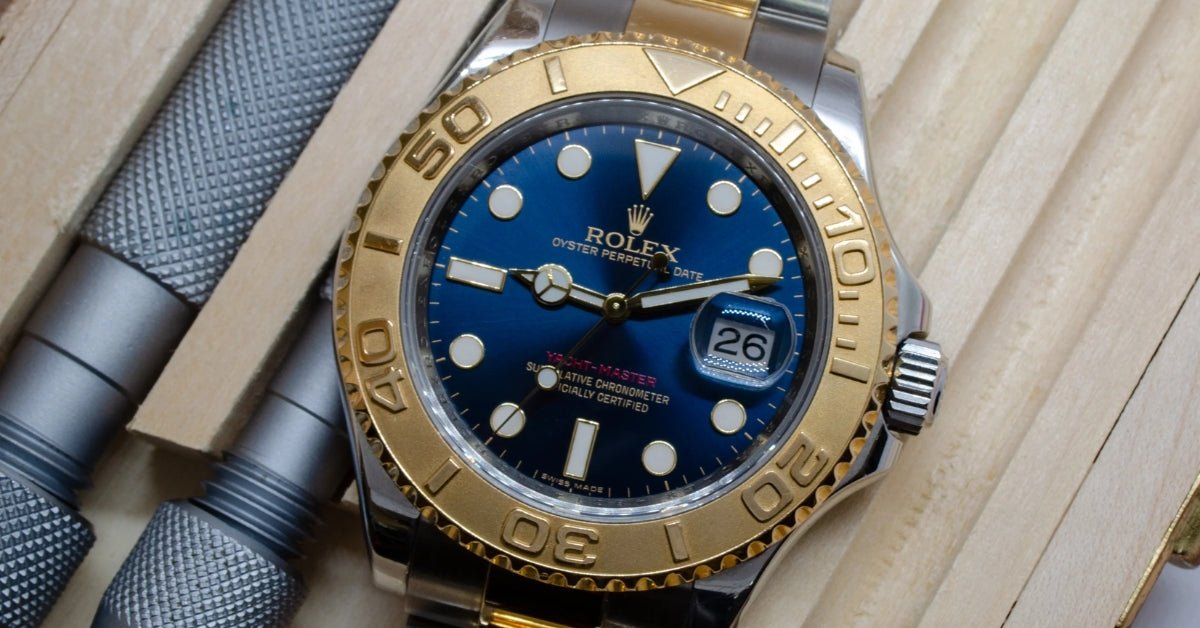
The 16623 is the two-tone Yacht-Master people forget exists. Everyone knows the Rolesium 16622 with its platinum bezel, and everyone knows the Everose 116621 that came later. In between sat this one: a 40mm Oystersteel case with an 18k yellow gold bezel, gold centre links, and a blue dial that has aged better than almost anything Rolex made in that era.
It's also a five-digit reference, which matters more for strap owners than it sounds. The bracelet on this generation is built differently from everything that replaced it, and that difference is the whole reason this guide exists.
Strap size and fit for the Yacht-Master 16623
The 16623 is a 40mm case with a 20mm lug width.
The Yacht-Master line runs three different widths depending on case size, so on Helvetus product pages select the 40mm option:
→ All rubber straps for the Rolex Yacht-Master
Two checks before you order:
- Smaller Yacht-Masters — the 35mm and 29mm two-tone references are a different case and a different width. Message support with your reference rather than guessing.
- The 42mm Yacht-Master and any Oysterflex model need different straps entirely. Neither is this guide.
On buckles, a genuinely useful note for this reference. The deployant version is designed around the modern Rolex deployant clasp. The 16623 came on the older flip-lock clasp of its generation, which isn't the same thing. If you want to reuse your original clasp, message support with your reference first — otherwise take the pin buckle version, which includes its own steel buckle and fits regardless. It's the option I'd default to on a five-digit watch.
What the 16623 is
Rolex built it into the mid-2010s, until the Everose Rolesor 116621 took over as the two-tone Yacht-Master 40.
The case is 40mm Oystersteel with the calibre 3135 inside, sapphire with a cyclops, date at three, and 100 m water resistance. The gold sits on the bezel, the centre links and the raised numerals — and the bezel is the thing people react to. It's polished 18k yellow gold with the numerals standing proud of a recessed surface, which is why a Yacht-Master bezel catches light differently to every other Rolex bezel.
One detail worth knowing, because it surprises owners: on the two-tone Yacht-Masters the winding crown is steel, not gold. Rolex did this across the bi-colour Yacht-Masters, including the Everose 116621 that followed. The full gold 16628 got a gold crown; the two-tones didn't.
Dials ran blue, white, champagne and mother-of-pearl. The blue is the one most people picture, and it's the one that makes this reference.
Why the 16623 in particular belongs on rubber
Because this is the generation with the bracelet that stretches. The five-digit Yacht-Masters use hollow centre links. Rolex went to solid links with the six-digit generation, which tells you plainly what the problem was. Hollow links stretch — gradually, cumulatively, and permanently. It never reverses, and it's one of the first things a buyer checks.
Now add the two-tone. On the 16623 those hollow centre links are the gold ones: soft, polished 18k sitting between brushed steel outer links that hide wear far better. So the bracelet has two ageing problems running at once, on the same components, and every day you wear the watch hard on it is a day you can't undo.
And the strap costs you nothing visually. The gold that makes a 16623 a two-tone is on the bezel and the raised numerals — the loudest, most recognisable gold on the watch, and it doesn't move. Take the bracelet off and it's still unmistakably a two-tone Yacht-Master. What leaves is the weight and the wear surface.
Then the obvious one. It's a Yacht-Master. It's rated to 100 metres, the bezel exists to time things on the water, and the reason yours has probably never been near a boat is that nobody takes a two-tone gold bracelet into salt spray. Rubber is what makes the watch usable as the thing it was designed to be.
Four strap colours for the 16623
1. Blue — the dial's own colour
Start here if you have the blue dial, which most owners do. Blue rubber runs the dial colour straight down the wrist and leaves the gold bezel as the single bright element in the middle. It's the most complete-looking combination this reference has, and it's the one that reads properly nautical rather than merely expensive.
Blue and yellow gold is also one of the oldest reliable pairings there is, and the Yacht-Master is the Rolex it suits best.
→ Blue rubber strap for the Rolex Yacht-Master
2. White — the summer one
On the white-dial 16623 this is like-for-like, and on the blue-dial version it's the strap that lightens the whole watch for warm weather. White against yellow gold reads clean and slightly sun-bleached in the right way, and it makes the raised gold numerals on the bezel stand out more than any dark strap can.
Best between May and September, and best near water.
→ White rubber strap for the Rolex Yacht-Master
3. Black — the one that makes the gold pop
Black is the contrast play. Against it, the gold bezel and the gold numerals separate hard from the steel case, and the watch looks sharper and a little smaller. It's also the most versatile strap you'll own for a two-tone, because it works with every dial the reference came with.
If you only buy one, buy this one.
→ Black rubber strap for the Rolex Yacht-Master
4. Beige — for the champagne dial
The tonal option, and the right answer if your dial is champagne. Beige, gold bezel and a warm dial become one continuous object, with the steel case as the only cool element in the composition. It's understated in a way that suits a 40mm watch and it looks considerably better in person than it does in a photo.
→ Beige rubber strap for the Rolex Yacht-Master
Navy, grey, light blue and more are in the Yacht-Master collection — just remember to select the 40mm option.
Related references
- 116621 — the Everose Rolesor that replaced it as the two-tone Yacht-Master 40. Same 40mm case, same 20mm fit.
- 116622 — the Rolesium version with the platinum bezel.
- 16622 — the five-digit Rolesium, same case and generation as this one.
- 16628 — the full 18k yellow gold Yacht-Master, and the reference the whole line launched with.
- Yacht-Master 42, 37 and 35mm — different cases, different widths.
Quick answers
What lug width is the Rolex Yacht-Master 16623? 20mm, on a 40mm case.
What do I select when ordering? The 40mm option. The 42mm and smaller Yacht-Masters use different widths.
Pin buckle or deployant? Pin buckle is the safe default here. The deployant version targets the modern Rolex deployant clasp, and the 16623 came on the older flip-lock of its generation — ask support before ordering the deployant.
Is the 16623 the same fit as the 116621 or 116622? Yes. All the 40mm Yacht-Masters take 20mm, so the same straps fit.
Before you order
The 16623 is a good watch on an ageing bracelet, and the bracelet is doing all the suffering. A strap takes the stretch problem out of daily wear, keeps the soft gold links off desks and door frames, and gives the watch back the job it was built for.
Helvetus straps for the Yacht-Master are cut for the 40mm case, come with a lifetime warranty on rubber, ship free worldwide with no import costs, and are worn by 50,000+ customers. Blue rubber under a gold bezel — try that one first.