


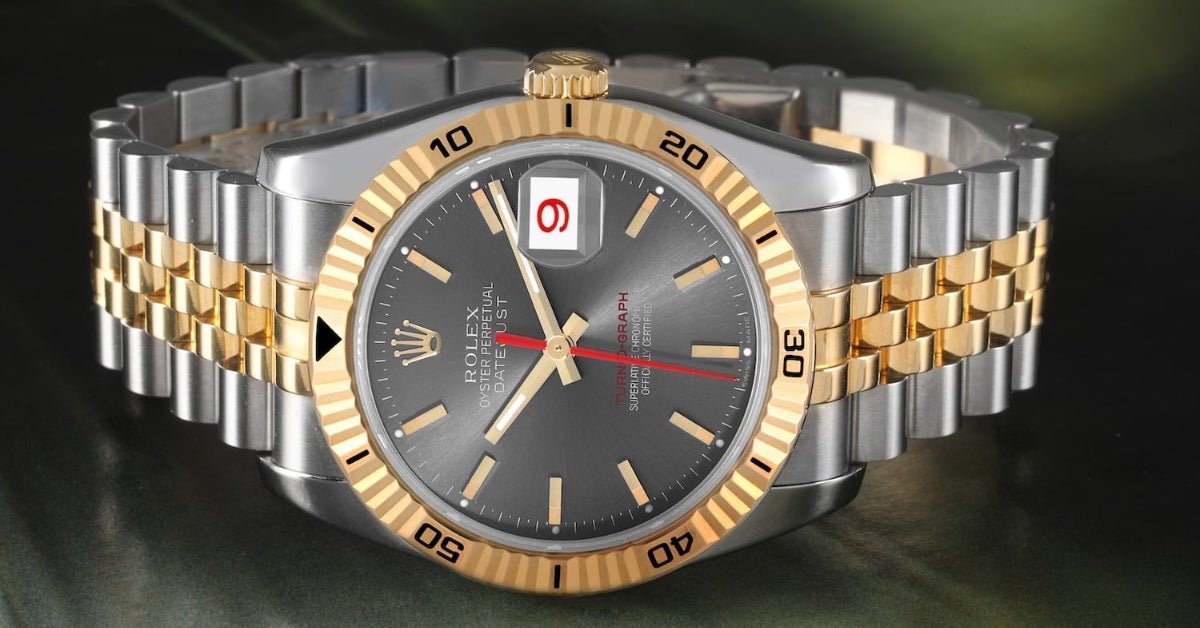
The 116263 is the strangest watch in the Datejust line, and almost nobody notices. Look at a two-tone Datejust and the gold bezel is decoration — a fluted ring that catches light and does nothing else. Look at a 116263 and the gold bezel turns. It's bidirectional, it's marked with a red arrow, and it measures elapsed time up to sixty minutes.
That makes this the only two-tone Datejust where the gold has a job. Rolex introduced it in 2004 to mark fifty years of the Turn-O-Graph, and it stayed in the catalogue until the line was retired at the start of the 2010s.
Strap size and fit — and where to actually look
The 116263 is a 36mm case with a 20mm lug width.
The important part: the Turn-O-Graph uses the Datejust 36 case. There is no separate Turn-O-Graph or Thunderbird strap range to hunt for, because there doesn't need to be. Everything in the Datejust 36 collection is cut for this exact case:
→ All rubber straps for the Rolex Datejust 36
There's no size to select. Pick a colour and a buckle and you're finished.
This is the single most common reason Turn-O-Graph owners never get round to a strap — they search their model name, find nothing, and assume nothing exists. The case underneath is a Datejust 36 and always has been.
One thing to check on your bracelet. The 116263 came on the five-piece Jubilee with a concealed Crownclasp, or on the Oyster with a fold-over clasp. If yours is the hidden type and you want to keep using it with the deployant version of a strap, message support with your reference first. The pin buckle version includes its own steel buckle and fits either way.
What the 116263 is
Rolesor construction: an Oystersteel 36mm case with an 18k yellow gold fluted rotating bezel and yellow gold centre links through the bracelet. Calibre 3135 inside, chronometer-certified, with a quickset date. Sapphire crystal with the Cyclops, 100 m water resistance, and the double-sealed Twinlock crown.
The six-digit generation brought a redesigned case with more tapered lugs, the fluted rotating bezel in place of the older engine-turned one, and a solid five-piece Jubilee with the concealed clasp. It also brought back the "Turn-O-Graph" text on the dial, along with a red seconds hand and the roulette date wheel — red numerals alternating with black.
Dials ran white, black, champagne and grey, and there was a Japanese limited edition that swapped the red seconds hand for a green one. If you have one of those, you own something genuinely scarce.
Why the gold bezel changes the argument
Here's the thing that separates this reference from every other two-tone Datejust.
Your gold isn't jewellery. It's the part you operate. On a 116233 or a 116203 the gold bezel is fixed — it sits there looking expensive. On the 116263 it rotates, and rotating it is the entire reason the watch exists. That means the softest, most valuable exterior surface on your watch is also the only moving part you touch by design.
You can't protect it. Turning the bezel is what it's for, and every turn is contact. What you can do is stop adding wear everywhere else — and the bracelet is where all the rest of it happens. Polished yellow gold centre links, sitting between brushed steel outer links that hide marks far better, catching every desk edge and door frame for twenty years.
The bezel stays on the watch no matter what you strap it to. The bracelet doesn't have to.
And there's a second effect, which is why owners who try this rarely go back. On a two-tone Jubilee, a Turn-O-Graph reads as a dressy Datejust that happens to have an unusual bezel. On a strap, the proportions shift and the bezel becomes the loudest thing on the watch — which is correct, because it's the only genuinely functional feature Rolex put there. The watch stops looking like a Datejust with an oddity and starts looking like what it is: the descendant of the first rotating bezel Rolex ever made, in 1953, a year before the Submariner.
Four straps for the 116263
This is a warm watch — yellow gold bezel, gold centre links, gold-toned markers on most dials. The best answers agree with that rather than fight it.
1. Brown — the one to order first
Warm metal wants a warm strap, and on a champagne-dialled 116263 brown is close to a like-for-like match: the dial, the bezel and the strap all sit in the same family, with the red seconds hand as the only contrast in the frame.
It's also the strap that most changes how the watch reads. Two-tone gold on brown rubber looks deliberate and current; the same watch on a two-tone Jubilee looks like it came from a different decade.
→ Brown rubber strap for the Rolex Datejust 36
2. Beige — for the white and light dials
Softer than brown and better on the white and silver executions. Beige lets the gold bezel be the brightest thing on the watch, which on a Turn-O-Graph is exactly where you want the eye — the bezel is the feature, so let it lead.
It's the summer version of pick one, and it flatters the 36mm size in a way darker straps don't quite manage.
→ Beige rubber strap for the Rolex Datejust 36
3. Green — gold's best partner
Green and yellow gold is one of the richest combinations there is, and it does something specific here: it makes a two-tone watch look chosen rather than inherited. Nobody ends up with a green strap by accident.
And if yours is the Japanese limited edition with the green seconds hand, this stops being a styling choice and becomes the obvious one.
→ Green rubber strap for the Rolex Datejust 36
4. Black — the reset
The straightforward option, and the right one if your dial is black. Against black rubber the gold bezel separates hard from the steel case and the red seconds hand snaps forward. It's the most versatile strap in the range and the easiest to live with.
→ Black rubber strap for the Rolex Datejust 36
Bordeaux, blue, white, grey and more are all in the Datejust 36 collection — everything there fits this case.
Related references
- 116264 — the same watch in steel with a white gold rotating bezel. Same 36mm case, same 20mm fit.
- 116261 — the Everose version from the same final generation.
- 116233 and the other two-tone Datejust 36 references — same case, same 20mm fit, fixed bezels.
- 116200 — the plain steel Datejust 36 of this generation.
- Five-digit Turn-O-Graphs (16253, 16263, 1625) — also 36mm Datejust cases, but older cases can differ. Check with support if yours is a four- or five-digit reference.
Quick answers
What lug width is the Rolex Turn-O-Graph 116263? 20mm, on a 36mm case.
Which collection do I order from? Datejust 36. The Turn-O-Graph shares that case, so there's no separate range to look for.
What's the difference between the 116263 and the 116264? The metal. The 116263 has a yellow gold rotating bezel and gold centre links; the 116264 is steel with a white gold bezel. Identical fit.
Is the bezel really functional? Yes. It's bidirectional and marked for sixty minutes — and it's the design that led to the Submariner and GMT-Master bezels a year later.
Before you order
A Turn-O-Graph is a tool watch that spent its whole life dressed as a Datejust, and the two-tone bracelet is the last thing keeping the disguise on. A strap takes it off in two minutes, and the gold links stop collecting marks while you're at it.
Helvetus straps for the Datejust 36 are cut for this exact case, come with a lifetime warranty on rubber, ship free worldwide with no import costs, and are worn by 50,000+ customers. Brown first — then look at the green.