


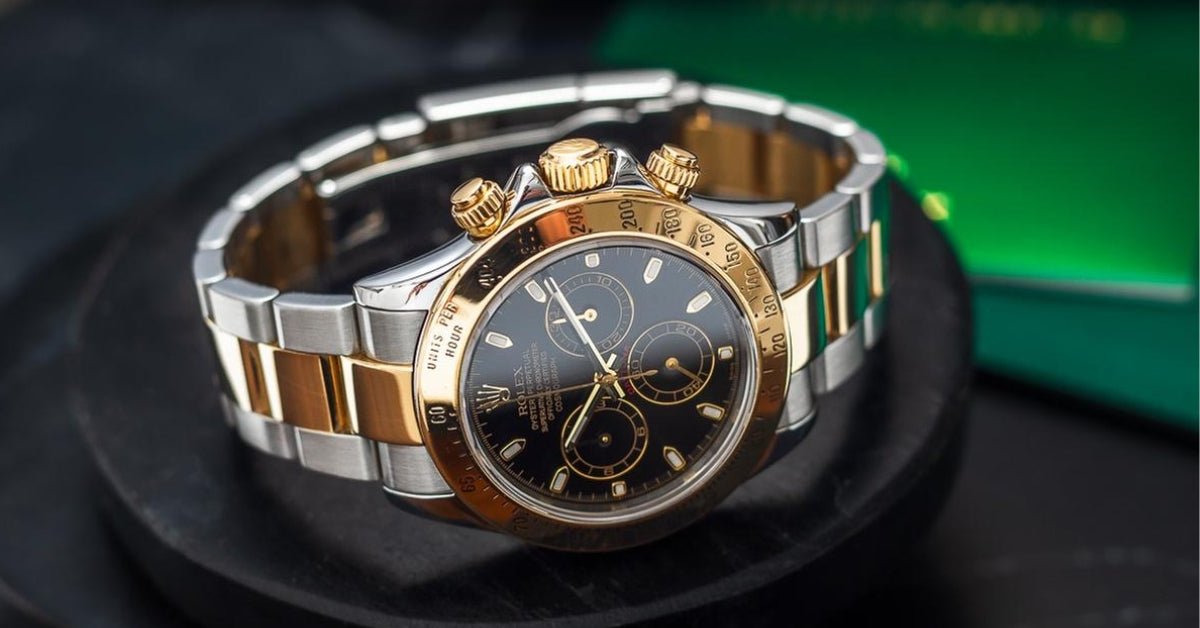
The 116523 is the two-tone Daytona that mattered. In 2000 Rolex finally put its own chronograph movement in the watch, and this is the Rolesor version of that moment — steel case, solid 18k yellow gold bezel, gold crown, gold pushers, gold centre links, and the first in-house automatic chronograph the brand ever made ticking away behind it.
It ran for sixteen years, which means there are a lot of them out there, in more dial variations than almost any other modern Daytona. And that dial range is exactly why strap choice is more interesting on this reference than on an all-steel one. Champagne, white, black, slate, the discontinued blue racing — each one wants something different.
Strap size and fit for the Daytona 116523
The 116523 is a 40mm case with a 20mm lug width. Every automatic Daytona since 1988 uses that combination, so there's nothing exotic to work out.
At Helvetus there's no size to select — the curved Daytona straps are made at 20mm and shaped to this case, so you pick a colour and a buckle and that's the order:
→ All rubber straps for the Rolex Daytona
The one thing to check before you order. These curved straps are built for Daytonas that came on a metal bracelet, which is exactly what your 116523 is. They are not for the leather-strap or Oysterflex Daytonas — so if you're actually looking at a 116518, 116519 or any Oysterflex reference, you want the Oysterflex replacement line instead. Different system entirely.
Pin buckle or deployant? The pin buckle version is the safe default and includes its own steel buckle. If you'd rather reuse your original clasp with the deployant version, message support with your reference first — the 116523 uses the pre-2016 clasp, not the current one, and it's worth a thirty-second check rather than a return.
What makes this reference the one it is
Rolex launched the 116523 in 2000 and built it until 2016.
Before that year, Daytonas ran on a modified Zenith movement. The calibre 4130 changed that: Rolex's first in-house automatic chronograph, column wheel, vertical clutch, 72 hours of reserve, and famously fewer components than what it replaced. The 116523 is the yellow Rolesor expression of that shift — the direct successor to the Zenith-powered 16523.
Gold sits on the bezel, the crown, the pushers and the centre links of the Oyster bracelet. Everything else is steel. The case is 40mm with screw-down pushers and a Triplock crown, good for 100 m, with the Easylink extension in the bracelet.
Over sixteen years it evolved in ways you can see without opening it: the earliest examples have slimmer, more needle-like chronograph hands, and the rehaut goes from plain to engraved partway through the run. Dials came in white, black, champagne, silver, slate and the blue racing variant, plus mother-of-pearl and diamond executions. They generally trade somewhere between $17,000 and $20,000 depending on which dial you're chasing.
In 2016 the 116503 replaced it, keeping the same case and the same movement. The upgrades were concentrated almost entirely in the bracelet.
Why a 116523 is worth putting on rubber
Remember what Rolex chose to upgrade. When the successor arrived, the case didn't change and the movement didn't change — the bracelet did. That tells you where this generation's weak point was, and it's the part you're wearing every day.
Polished gold shows everything. The centre links on a two-tone Oyster are polished 18k, sitting between brushed steel outer links that hide wear beautifully. Gold is soft, polished gold is unforgiving, and none of it buffs out without removing material. Desk edges, steering wheels, door handles — the bracelet takes all of it while the case sits up top doing fine.
And the watch is a driving chronograph. That's the part people forget with a two-tone. On a full steel-and-gold Oyster the 116523 reads dressy, almost formal, and a lot of owners end up saving it. On black rubber it reads like what it actually is: a racing chronograph with a serious movement inside. Lighter on the wrist, easier to use, and far more likely to get worn.
The gold that makes it a Rolesor — bezel, crown, pushers, markers — all lives on the head. Nothing about the watch's identity leaves with the bracelet.
Four strap colours for the 116523
1. Black — the racing default
Black rubber is the strap that turns the volume down on the metal and up on the watch. Against black, the gold bezel stops looking like jewellery and starts looking like a design element — a bright ring framing a dial you can actually read.
It works with every dial this reference came with, and it's the version to buy if the goal is simply to wear the watch more often.
→ Black rubber strap for the Rolex Daytona
2. Beige — for the champagne dial
The champagne dial with black subdials is the signature 116523 configuration, and it's the one that looks slightly lost on a bracelet — too much warm metal, all competing. A beige strap pulls the whole watch into one tonal family: champagne dial, gold bezel, sand-coloured strap, with the black registers left as the only contrast.
It's a quietly expensive-looking combination and almost nobody does it. If you have the champagne dial, try this before anything else.
→ Beige rubber strap for the Rolex Daytona
3. Black with a blue LuxLine® — for the blue racing dial
The blue racing dial is the 116523 variant collectors actually hunt, and it deserves a strap that acknowledges it rather than ignoring it. This one is black with a single blue line running down the centre, so the base stays serious and the accent picks up the dial exactly.
It's the most literal use of the racing idea in the whole Daytona range, and it stops well short of a bright blue strap, which on a gold-bezel watch would be a lot.
→ Black with blue LuxLine® rubber strap for the Rolex Daytona
4. Grey — for the slate and silver dials
The slate sunburst and silver dials are the coolest-toned options in the 116523 range, and grey rubber is the only colour that meets them halfway. It keeps the watch monochrome from the dial outward and leaves the gold as the single warm element in the whole composition.
This is the businesslike one. It looks deliberate under a cuff in a way black doesn't quite manage.
→ Grey rubber strap for the Rolex Daytona
The rest of the range, including brown, green, white and the other LuxLine® options, is in the Daytona collection.
Same case, same 20mm fit
- 116503 — the ceramic-bezel two-tone that replaced it in 2016.
- 116520 — the all-steel version of the same watch, same case, same fit.
- 16523 — the Zenith-powered two-tone predecessor. Also 40mm and 20mm.
- 116528 — the full yellow gold version.
- 116518 / 116519 / any Oysterflex reference — these came on leather or Oysterflex, not a bracelet. Different strap system, see the Oysterflex line.
Quick answers
What lug width is the Rolex Daytona 116523? 20mm. The case is 40mm, and every automatic Daytona shares that 20mm lug width.
Do I need to select a size? No. The curved Daytona straps are pre-sized at 20mm for this case.
Will a curved rubber strap fit my 116523? Yes — it came on a metal bracelet, which is what these straps are made for. The exception is the leather-strap and Oysterflex Daytonas, which need the separate Oysterflex line.
Can I keep my original clasp? Possibly, with the deployant version, but the 116523 uses the pre-2016 clasp — check with support before ordering. The pin buckle version sidesteps the question and comes with its own buckle.
Before you order
The 116523 is a watch that gets left in a box because it looks too smart for a normal Tuesday. A strap fixes that, and it takes the pressure off the one part of the watch that actually wears out.
Helvetus straps for the Daytona are cut for the 40mm case, come with a lifetime warranty on rubber, ship free worldwide with no import costs, and are worn by 50,000+ customers. Put the two-tone Oyster in the box and give the chronograph its life back.