


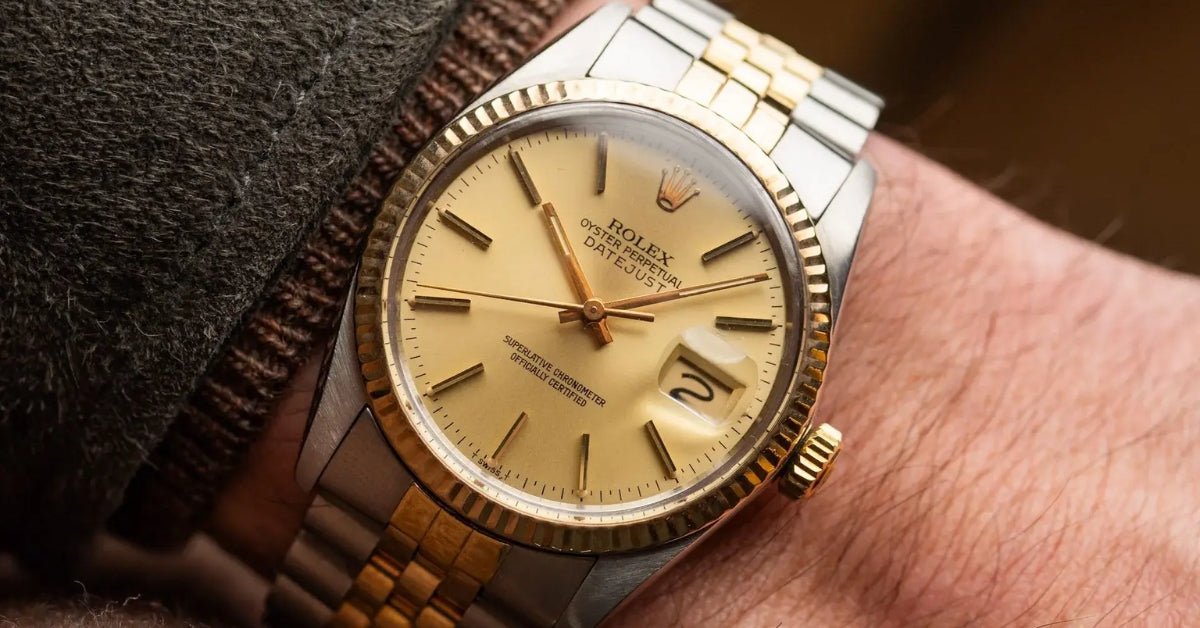
The 16013 is probably the most-worn luxury watch configuration ever made. Steel case, 18k yellow gold fluted bezel, gold centre links, Jubilee bracelet, champagne dial. Rolex built it in enormous numbers through the late seventies and eighties, and if you picture "a gold Rolex" without thinking too hard, this is roughly what your brain produces.
That ubiquity is the interesting part, and it changes the strap conversation completely.
Strap size and fit for the Datejust 36 (16013)
The 16013 is a 36mm case with a 20mm lug width. Around 12mm thick and 44mm lug to lug, so it wears flat and disappears under a cuff.
There's no size to select at Helvetus — everything in the Datejust 36 collection is made for this case:
→ All rubber straps for the Rolex Datejust 36
Pick a colour, pick a buckle, done. The Datejust 36 has used the same 20mm width across every generation and every metal, so a strap bought for this watch will fit any Datejust 36 you buy later.
On buckles, take the pin buckle. The deployant version is built around the modern Rolex deployant clasp, and your 16013 came on a period clasp from the seventies or eighties — a different fitting. The pin buckle includes its own steel buckle and fits regardless. If you want to reuse your original clasp, message support with your reference first rather than finding out afterwards.
What the 16013 is
It's the two-tone version of the five-digit Datejust: an Oystersteel case with an 18k yellow gold fluted bezel and gold centre links running through the bracelet, on either the Jubilee or the Oyster.
This generation is where the Datejust got genuinely easier to live with. It brought the calibre 3035 and its quickset date — which sounds trivial until you've spent five minutes winding a 1601 through twenty-four hours to change the date. The crystal is still acrylic; sapphire didn't reach the Datejust until the 162xx references that followed.
Dials came in champagne, silver, black, blue and a range of textured and painted variants. The lume is tritium, so on almost every surviving example the markers and hands have gone somewhere between pale cream and warm tan.
Why a strap matters more on a common reference, not less
Here's the thing nobody says about the 16013: nothing about it is rare, so condition is the only variable you control.
Rolex made these in quantities that make scarcity irrelevant. There is no dial configuration, no serial range and no production quirk that's going to carry an ordinary 16013. What separates a tired example from a good one — and the price gap is large — is entirely down to how it has been looked after.
And the bracelet is where that shows first. Long before the case looks worn, a two-tone Jubilee from this era tells you everything: hollow links that have stretched, gold centre links gone soft and hazy from decades of desk contact, a clasp that no longer clicks properly. Buyers check the bracelet before they check anything else, because on a reference this common it's the fastest read available.
Stretch doesn't reverse, and polished gold doesn't come back — every polish removes metal permanently, and there isn't much of it on a two-tone bracelet to begin with. So on a mass-produced reference, protecting the bracelet is disproportionately valuable, because it's the one lever you have.
And the dial ages in your favour. That cream tritium is the other thing buyers pay for, and unlike the bracelet it gets better with time rather than worse. The valuable ageing happens on the dial. The destructive ageing happens on the bracelet. Move the wear.
Four straps for the 16013
Warm metal, warm patina, forty years of tan on the markers. The best answers here agree with that.
1. Beige — the one that matches the lume
Start here. Your hour markers and hands have gone cream, and beige rubber meets them exactly — the whole watch reads as one warm, coherent object instead of a gold watch with an aged dial in the middle of it.
On a champagne-dialled 16013 it's close to perfect, and it's the pairing that makes forty years of tritium look like the point rather than the age.
→ Beige rubber strap for the Rolex Datejust 36
2. Brown — the deeper version of the same idea
Brown does what beige does with more contrast. It anchors the watch, gives the gold bezel something dark to sit against, and it suits the black and blue dials better than beige does.
It's also the strap that most changes how the reference reads. Two-tone gold on a Jubilee looks like 1985. The same watch on brown rubber looks deliberate.
→ Brown rubber strap for the Rolex Datejust 36
3. Black — the reset
The safe one, and the right one if you want the 16013 to stop looking vintage altogether. Against black, the gold separates hard from the steel case and the watch reads sharper, cleaner and considerably more modern than its age suggests.
Most versatile strap in the range, and the easiest to live with day to day.
→ Black rubber strap for the Rolex Datejust 36
4. Green — the one that makes a common watch look chosen
Given how many 16013s exist, there's an argument for doing something nobody else does. Green and yellow gold is a genuinely rich combination, it flatters champagne and silver dials, and it's the pick that turns "a two-tone Datejust" into your two-tone Datejust.
Nobody arrives at a green strap by accident, which on this reference is the whole point.
→ Green rubber strap for the Rolex Datejust 36
Bordeaux, blue, white, grey and more are in the Datejust 36 collection — everything there fits this case.
Same case, same 20mm fit
- 16014 — the steel version with a white gold fluted bezel.
- 16030 — steel with an engine-turned bezel.
- 16018 — the full 18k yellow gold version.
- 1601 — the four-digit predecessor, acrylic crystal, no quickset.
- 16233 — the six-digit-era successor to this exact configuration.
- 116234 and 126200 — modern Datejust 36s. Still 20mm.
Quick answers
What lug width is the Rolex Datejust 16013? 20mm, on a 36mm case.
Do I need to select a size when ordering? No. Everything in the Datejust 36 collection is made for this case.
Pin buckle or deployant? Pin buckle. The deployant version targets the modern Rolex deployant clasp, not the period clasp your 16013 came with.
Will a strap hurt the value of a vintage Datejust? The opposite — provided you keep the bracelet. Wearing the watch on rubber and storing the original bracelet is how you arrive at a sale with an unstretched, unworn two-tone Jubilee, which is exactly what buyers pay for.
Before you order
On a reference Rolex made by the tens of thousands, condition is the entire conversation, and the bracelet is the part that fails first. A strap costs a fraction of what the bracelet is worth and takes the daily wear off it completely.
Helvetus straps for the Datejust 36 are cut for this exact case, come with a lifetime warranty on rubber, ship free worldwide with no import costs, and are worn by 50,000+ customers. Beige first, against that cream lume — it's the combination this watch has been heading toward for forty years.