


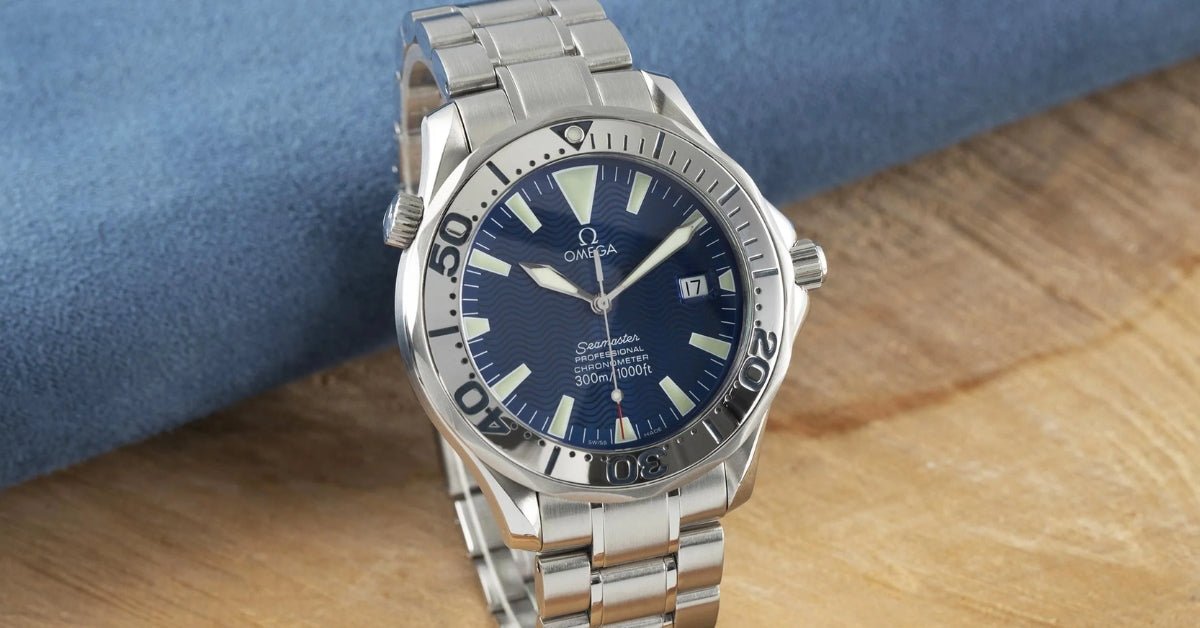
Of all the wave dials Omega has ever put in a Seamaster, exactly one earned its own name. Collectors call ref. 2255.80 the "Electric Blue," and the reason is obvious the moment sunlight hits it: the metallic dial doesn't sit on one colour, it moves — deep navy at one angle, almost aquamarine at another, with the wave pattern flickering in between. Omega built it through the late 1990s and into the 2000s, paired it with the sword hands from the 2254.50 and the case and calibre from the Bond-era Seamaster, and then never made anything like it again. No later generation, in any colour, has come close to this dial.
Which makes strap choice unusually interesting — because on this watch, you're not matching a colour. You're choosing which end of the dial's range to anchor.
Sizing: one number, one trap
The full-size Electric Blue takes a 20mm strap. The dedicated buyer's guides for this family state the 20mm lug width outright for every full-size model, the case carries over from the Bond Seamaster whose 20mm fit is thoroughly documented, and Omega's own sheet for the later watch built on this same case says the same. Our strap pages for the model already have 20mm selected by default, so there's nothing to change — just don't "correct" it to something else.
The trap is the mid-size. The Electric Blue also came in a 36.25mm case, and those watches take 18mm, not 20mm. If your watch wears small and you're not sure which you have, measure between the lugs before ordering — the two sizes look similar in photos and share the same dial.
A few family notes so nobody gets confused: if your caseback area reads 2055.80, that's the identical watch delivered on the other bracelet style. The quartz versions share the dial but skip the "chronometer automatic" text. There's a titanium version with a brushed bezel. And the Royal Navy Clearance Divers and Ian Thorpe limited editions are full-size cases too — everything below applies to them exactly.
Why this one became a cult watch
Three honest reasons. First, the dial — metallic, textured, alive in a way Omega has been too conservative to repeat since. Second, the bezel: unlike its black-dialled sword-hand sibling, the Electric Blue wears a solid polished steel bezel with recessed black markings — no paint to fade, no aluminium to scuff, and if it ever picks up scratches, a watchmaker can simply polish them out. Third, the lume. Owners consistently rank this generation's glow among the best Omega has ever produced — the broad sword hands and oversized markers light up like instruments, not decoration.
Inside sits the calibre 1120, the chronometer-certified automatic that powered the era: 44 hours of reserve, quick-set date, hacking seconds, and a reputation for running for decades without drama. It's the direct predecessor of Omega's first co-axial movement, which makes this watch the last of the pre-co-axial Seamasters — the end of one chapter rather than the start of the next. The case backs it up with 300 metres of water resistance, a helium escape valve, proper crown guards, and a very wearable 12mm height.
These sold in big numbers for over a decade and survive beautifully, which means the market always has good examples — and a lot of owners quietly looking for the right second strap.
The dial is a range — pick your end of it
Because the Electric Blue shifts from near-navy to near-aquamarine depending on the light, every strap below is really a decision about which version of the dial you want to emphasise. That's the whole guide in one sentence.
1. Light blue — the aquamarine end
Here's the thing about this watch: nobody bought it to be subtle. The dial is the brightest, most flamboyant blue Omega ever shipped, and a light blue rubber strap is the one choice that speaks its language fluently. It picks up the dial at its sunniest angle — that aquamarine flash — and holds it there permanently. On almost any other Seamaster this strap would be the bold pick; on the Electric Blue it's simply the honest one. Summer watch, unlocked.
2. Navy blue — the deep end
The same logic, run the other way. A navy blue rubber strap anchors the dial at its darkest angle, so the metallic surface reads as the bright, moving thing against a still, deep base. This is the everyday configuration — quiet enough for the office, tonal enough to look deliberate, and the matte rubber under that shimmering dial gives the watch a depth the polished bracelet never did.
3. White — the torch
The Electric Blue's other superpower is light itself: sword hands and markers with lume owners call some of the strongest Omega ever made. A white rubber strap answers exactly those elements — the only non-blue parts of the watch — and turns the whole piece crisp and nautical. Blue and white is the oldest pairing on the water, and no dial rewards it like a metallic one. The holiday strap, and a better dress-down option than most people expect.
4. Black — the frame
Gallery logic: the darker the frame, the louder the painting. A black rubber strap doesn't calm the Electric Blue down — it isolates it, making the dial the single point of colour on your wrist. It's also the most versatile strap in the drawer and the natural pick for anyone who wants the watch to surprise people at second glance instead of first.
The short version
20mm on the full-size (18mm if yours is the mid-size), and then simply decide which Electric Blue you want: the aquamarine one, the deep one, the crisp one, or the framed one.
Every strap in our Seamaster 300 collection is built for this case family, ships with spring bars included, and carries a lifetime warranty on rubber — plus free worldwide shipping and no import costs, which is a big part of why over 50,000 customers have trusted us with their watches. Our write-ups of every other Omega live in the Omega strap guide hub. Omega never made this dial again — wear it like the one-off it turned out to be.